Correlation of English and French Proficiency among Indonesian High School Students: A Quantitative Analysis
Youssouf Haïdara 1* | ||
University of Bamako/FLSL, Bamako, MALI |
Abstract. Multilingualism is increasingly vital in a globalized world, yet foreign language acquisition remains challenging. Indonesia's complex linguistic landscape presents unique opportunities and challenges for language education, particularly concerning the interplay between English and French as foreign languages. However, there is limited research that explores the correlation between English and French proficiency among Indonesian high school students. Understanding this relationship is crucial for optimizing language education policies and practices. Thus, this study aimed to investigate the correlation between English and French language proficiency among 10th-grade students in Yogyakarta, Indonesia. A quantitative correlational design was employed, utilizing students' final exam (UAS) scores in English and French as measures of proficiency. Pearson product-moment correlation analysis was conducted to determine the strength and direction of the relationship. The sample comprised 31 students from a public high school (SMAN 9 Yogyakarta) enrolled in both English and French language courses. A significant positive correlation (r = 0.613, p < .05) was found between English and French proficiency scores. However, descriptive statistics revealed concerningly low English proficiency levels, with all students scoring below the minimum passing grade. French proficiency was comparatively higher, but a majority still did not meet the passing standard. These findings highlight the interconnectedness of language learning and support the potential for cross-linguistic skill transfer. The low English proficiency underscores the need for improved language instruction. The study's findings offer valuable insights for educators and policymakers seeking to enhance foreign language education in Indonesia and promote effective multilingualism. The positive correlation suggests that strengthening English language skills may have a positive impact on French language acquisition. Further research is needed to explore the specific factors influencing this relationship and to develop targeted interventions to improve language learning outcomes.
Keywords: English language, French language, SLA.
Received: February 20, 2025. Accepted: April 20, 2025. *Correspondence: haidar@bamako.edu Youssuf Haidara English Department, University of Bamako/FLSL, Bamako, Mali | |
Copyright: © 2025 by the authors. Published by KHATEC, Pontianak, Indonesia. This is an Open Access article distributed under the terms of the Creative Commons Attribution License (Creative Commons Attribution-ShareAlike 4.0 International License), which permits unrest-ricted use, distribution, and reproduction in any medium, provided the original work is properly cited. |
INTRODUCTION
The increasing interconnectedness of the 21st-century global landscape underscores the significance of multilingualism. With over 7,000 languages spoken worldwide, multilingualism is not merely a phenomenon but a crucial factor in addressing global challenges and fostering intercultural understanding (Regester & Norton, 2018; Stein-Smith, 2021). This linguistic diversity is evident in various contexts, from the vibrant linguistic landscape of urban centers like Montreal (Leimgruber, 2020) to the multilingual signs within educational settings in Yogyakarta, Indonesia (Andriyanti, 2019). While multilingualism offers numerous benefits, significant challenges remain, including limited access to education in understood languages and widespread low literacy rates (Regester & Norton, 2018).
Foreign language acquisition, in particular, is gaining increasing importance due to its profound impact on cognitive development, career prospects, and cross-cultural communication (Fox et al., 2019; Martinaj, 2020; Stein-Smith, 2021). Proficiency in foreign languages has been linked to enhanced cognitive flexibility, delayed onset of dementia, and improved employment opportunities, potentially even mitigating income inequality (Churkina et al., 2023; Hahm & Gazzola, 2022). The ability to communicate effectively across cultures is increasingly recognized as an essential skill in a globalized world, further emphasizing the need for foreign language proficiency (Leonet & Orcasitas-Vicandi, 2022; Stein-Smith, 2021). However, despite these benefits, many countries, including the United States, face a significant foreign language deficit (Stein-Smith, 2021).
Learning a foreign language, however, is a complex process fraught with challenges. Adults often face greater difficulties in language acquisition compared to children due to a combination of environmental, cognitive, and motivational factors (Caldwell-Harris & MacWhinney, 2023; Steber & Rossi, 2021). Linguistic complexity, cultural competency, and individual learning styles all contribute to the intricacies of second language acquisition (Kuiken, 2022; Stone, 2023). Successful language learning hinges on creating conducive learning environments, fostering positive psychological factors like engagement and resilience, and tailoring pedagogical approaches to individual learner characteristics (Qiao, 2024; Papi & Khajavy, 2021; Kang et al., 2021; Wang et al., 2021).
While research on English language education in Indonesia is extensive, studies focusing on French language education, particularly at the secondary school level, remain limited (Zein et al., 2020). Existing research indicates challenges in French language instruction at the university level, often characterized by rote learning and repetitive teaching methods (Andriani et al., 2022). Indonesia's diverse linguistic landscape, with over 700 living languages (Hamied & Musthafa, 2019), further complicates language education policies and practices. Moreover, a growing body of research suggests a potential interrelationship between proficiency in different foreign languages, possibly due to transferrable metacognitive strategies, increased motivation, and enhanced metalinguistic awareness (Howard & Oakes, 2021; Markey, 2022; Razkane & Diouny, 2022; Spinelli, 2023). This potential interrelationship is particularly relevant in the Indonesian context, where both English and French are learned as foreign languages and are subject to various cultural and linguistic influences (Fauziati, 2017; Marcellino, 2015; Mahriyuni et al., 2024).
Understanding how proficiency in one foreign language might influence the acquisition of another has significant implications for language education pedagogy and curriculum design. This study, therefore, aims to investigate the correlation between English and French language proficiency among high school students in Yogyakarta, Indonesia. Specifically, the research seeks to: (1) describe the level of English language proficiency among 10th-grade students; (2) describe the level of French language proficiency among the same student cohort; and (3) examine the correlation between English and French language proficiency. The novelty of this research lies in its focus on the specific context of Indonesian secondary education, where both English and French are foreign languages. Furthermore, by examining this correlation among high school students, this study offers significant insights into the potential for leveraging existing language skills to facilitate foreign language acquisition in multilingual settings. The findings of this study could inform the development of more effective language teaching methodologies and potentially contribute to improved language learning outcomes for Indonesian students. Previous research conducted in other non-native contexts also demonstrates a positive correlation between English and another foreign language (Hummel, 2009; Montgomery & Spalding, 2005; Yang, 2023). Factors influencing high schoolers' language learning, which range from computational thinking to learning strategies, are also synthesized to provide a holistic picture regarding the research context (Ismail & Al-Ajmi, 2024; Bećirović et al., 2021; Bounou et al., 2023; Dagenais & Jacquet, 2008; Liu & Han, 2022). Specifically, this research aims to investigate this correlation in the Indonesian context, which is rarely studied.
METHOD
This quantitative correlational study investigated the relationship between English and French language proficiency among high school students. Correlational research involves collecting data to determine the existence and strength of relationships between two or more variables (Sukardi, 2005). A quantitative approach was employed as the data consisted of numerical scores, specifically students' final exam (UAS) scores in English and French, and were analyzed using statistical methods (Sugiyono, 2013).
The study focused on two variables: English language proficiency (independent variable) and French language proficiency (dependent variable), both measured using students' final exam scores. This aligns with the understanding that the independent variable influences the dependent variable (Sugiyono, 2012). The research sought to determine whether English proficiency influences French proficiency. The population comprised all 10th-grade students at SMAN 9 Yogyakarta, Indonesia, while the sample consisted of 31 students from class X IIS, purposefully selected due to their enrollment in both English and French language courses.
Data collection employed a documentation technique, utilizing existing records of students' final exam scores in English and French obtained from their respective teachers (Sukardi, 2005). This constitutes secondary data as it was collected through pre-existing documents rather than directly from the participants (Sugiyono, 2013). The study was conducted from March 9th to April 6th, 2017, at SMAN 9 Yogyakarta. The instruments used were the school's standardized final exams for English and French, developed based on pre-defined curriculum guidelines. While content validity was ensured through alignment with curriculum objectives, reliability was not formally assessed in this study. Before correlational analysis, data were screened for normality, homogeneity of variance, and linearity using SPSS 22. Descriptive statistics were used to characterize the sample and the distribution of language proficiency scores. Finally, Pearson Product-Moment correlation analysis was conducted to determine the strength and direction of the relationship between English and French language proficiency.
RESULTS AND DISCUSSION
Results
This study investigated the correlation between English and French language proficiency among 31 tenth-grade students in the Social Sciences track (IIS) at SMAN 9 Yogyakarta, Indonesia. The primary data source consisted of students' final semester examination (UAS) scores in both languages, providing a quantitative measure of their respective proficiency levels. Prior to conducting the correlational analysis, the data underwent rigorous scrutiny to ensure its suitability for parametric statistical procedures. This involved testing for normality, homogeneity of variance, and linearity – crucial assumptions that must be met for accurate and reliable results.
Table 1. Descriptive Analysis of English Proficiency
Score | N | Lowest Score | Highest Score | Mean | SD |
English | 31 | 25.00 | 72.50 | 55.2419 | 12.99607 |
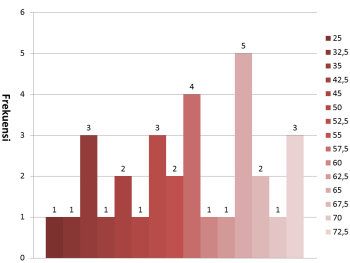
Figure 1. Distribution of English Score
Descriptive statistical analysis was performed to provide a preliminary understanding of the students' performance in each language. For English, the mean score was 55.24 out of a possible maximum score, with a standard deviation of 13. This indicates a relatively wide dispersion of scores around the average. Notably, the highest score achieved was 72.5 and the lowest was 25. A crucial point of comparison is the Minimum Competency Standard (KKM) set by the school for passing each subject. For English, the KKM was 77. Comparing the students' scores against this benchmark revealed a concerning finding: none of the students achieved a score at or above the KKM. This translates to a 0% pass rate for English in the sampled group, suggesting a significant gap between student performance and the expected proficiency level. A frequency distribution of the English scores further reinforced this observation, visually depicting the concentration of scores well below the KKM.
Table 2. Descriptive Analysis of French Language Proficiency
Score | N | Lowest Score | Highest Score | Mean | SD |
French | 31 | 49.17 | 91.67 | 74.6503 | 9.01035 |
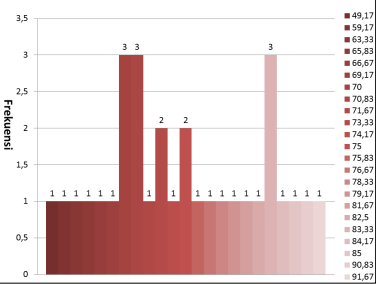
Figure 2. Distribution of French Score
In contrast, the descriptive analysis of French painted a more nuanced picture. The mean score for French was 74.65, with a standard deviation of 9.01. This indicates a less dispersed distribution of scores compared to English, suggesting a greater degree of homogeneity in French proficiency among the students. The highest score achieved in French was 91.67, while the lowest was 49.17. Using the KKM for French, which was set at 78, revealed that 11 students (35.5%) achieved a passing score. While this represents a considerably higher success rate than English, it still indicates that a majority of the students (64.5%) did not meet the minimum required proficiency level in French.
Prior to applying inferential statistical methods, it was crucial to verify whether the data met the necessary assumptions. These assumptions are paramount for ensuring the validity and reliability of the correlation analysis.
Table 3. Homogeneity of Variance
Variables | Lavene Stats | df1 | df2 | Sig. | Desc. |
Eng & France | 1.658 | 7 | 16 | 0.19 | Homogenous |
The Levene's test was used to assess the homogeneity of variance between the English and French scores. A non-significant result (p > .05) indicated that the variances were homogenous, meaning the spread of scores in both groups was comparable. This satisfied a critical assumption for using Pearson's correlation coefficient.
Table 4. Kolmogorov-Smirnov Test of Normality
Variable | N | p-value | Desc. |
English Score | 31 | 0.2 | Normal |
French Score | 31 | 0.2 | Normal |
The normality of the data distribution for each language was assessed using the Kolmogorov-Smirnov test. Non-significant results (p > .05) for both English and French indicated that the data for each language was normally distributed, further validating the use of parametric statistical procedures.
Table 5. Linearity Test result
Variables | Db | F | P-value | Desc. |
Eng & France | 13:16 | 0.540 | 0.866 | Homogenous |
The linearity assumption, which posits a straight-line relationship between the two variables, was evaluated. The test confirmed the existence of a linear relationship between English and French scores, justifying the use of Pearson's correlation.
Table 6. Pearson Product-Moment Result
Variables | N | Fstat | Ftable | Desc. |
Eng & France | 31 | 0.613 | 0.355 | Positive and significance |
Having confirmed the fulfillment of statistical prerequisites, Pearson Product-Moment correlation analysis was conducted to ascertain the strength and direction of the relationship between English and French proficiency. The analysis yielded a correlation coefficient (r) of 0.613, which was statistically significant (p < .05). This positive correlation coefficient indicates a moderately strong positive relationship between English and French language proficiency. In simpler terms, students who performed well in English tended to perform well in French, and vice versa. This positive correlation aligns with the theoretical underpinnings of language learning, suggesting that certain cognitive abilities and language learning strategies may be transferable across languages. The calculated r-value surpassed the critical value obtained from the statistical table (0.355 for N=31 at a 5% significance level), further solidifying the statistical significance of the findings. This implies that the observed relationship is unlikely due to chance and there is a genuine positive association between the variables.
Discussion
This study investigated the correlation between English and French language proficiency among Indonesian high school students, revealing a significant positive relationship between the two. This finding aligns with broader global trends emphasizing the importance of multilingualism and its cognitive, economic, and sociocultural benefits, as highlighted by Regester and Norton (2018) and Stein-Smith (2021). The vibrant linguistic landscapes observed in urban centers like Montreal (Leimgruber, 2020) and the diverse language use in educational settings (Andriyanti, 2019) underscore the real-world relevance of multilingualism and the interconnectedness of language learning. Our findings echo the research by Fox et al. (2019), Martinaj (2020), and Stein-Smith (2021), which emphasizes the increasing importance of foreign language acquisition in a globalized world for cognitive enhancement, career advancement, and effective cross-cultural communication.
The positive correlation between English and French proficiency resonates with studies suggesting the transferability of language skills. Razkane and Diouny (2022) demonstrated the transfer of metacognitive reading strategies from English (L3) to French (L2), enhancing reading comprehension. Similarly, Markey (2022) emphasized the role of metalinguistic awareness and strategy use in leveraging bilingual experience for new language learning. Our findings provide further empirical support for these contentions, highlighting that proficiency in one foreign language, in this case English, can facilitate the acquisition of another, such as French, potentially through the transfer of underlying linguistic knowledge and cognitive strategies. This aligns with Spinelli's (2023) discussion of Sparks' Linguistic Coding Differences Hypothesis, suggesting a positive influence of L1 skills on L2 learning, which could extend to the relationship between L2 and L3 acquisition. The observed correlation also suggests that the motivational factors observed by Howard and Oakes (2021) in L1-English learners of French as an L3 might play a role in the Indonesian context as well. If students experience success in learning English, this could potentially increase their motivation and confidence in tackling French, leading to higher proficiency in both.
However, our study also revealed stark differences in the overall proficiency levels in English and French. The significantly lower English scores, with a 0% pass rate based on the school's KKM, contrast sharply with the relatively higher French proficiency, albeit with a still substantial failure rate. This discrepancy requires a nuanced analysis considering the specific challenges and contextual factors influencing language learning in Indonesia. While the study by Yang (2023) showed a positive correlation between English and French among Chinese trilingual learners, it also underscored the importance of a threshold level of English proficiency for this correlation to manifest. The low English proficiency in our sample might suggest that many students haven't reached this crucial threshold, potentially hindering their French language development as well.
The observed low English proficiency aligns with the concerns raised by Stein-Smith (2021) regarding the foreign language deficit in various countries. It also reflects the challenges in Indonesian language education highlighted by Zein et al. (2020), including competing ideologies, sociocultural factors, and religious values that may impact language learning policies and practices. Furthermore, Marcellino (2015) pointed to the influence of cultural backgrounds and learning patterns, such as rote memorization, on Indonesian students' language acquisition. This resonates with Andriani et al.'s (2022) observations of repetitive teaching approaches and overreliance on rote learning in French language instruction at Indonesian universities. It's plausible that similar pedagogical approaches at the secondary level might be contributing to the low English proficiency observed in our study.
The relatively higher French proficiency, while still below desired levels, suggests that specific factors might be at play. It's possible that the novelty of learning French, compared to the more established presence of English in the Indonesian curriculum, could lead to increased student motivation and engagement, resulting in better performance. The smaller class sizes typical of specialized foreign language courses like French might also allow for more individualized attention and targeted instruction, contributing to higher proficiency levels.
The findings also challenge the simplistic assumption that higher proficiency in one language automatically translates to higher proficiency in another. While a positive correlation exists, it's essential to acknowledge the complexity of language acquisition and the influence of individual learner differences, as highlighted by Chuandai Qiao (2024). Factors like aptitude, motivation, learning styles, and exposure to the target language outside of the classroom can significantly impact language learning outcomes (Papi & Khajavy, 2021; Xin Kang et al., 2021; Yongliang Wang et al., 2021). The complexities of interlanguage development, as explored by Fauziati (2017) and Mahriyuni et al. (2024), further contribute to the nuanced picture of language learning in the Indonesian context. Common errors observed in Indonesian learners' language production, including vocabulary borrowings and grammatical mistakes, highlight the ongoing process of linguistic development and the challenges in achieving native-like proficiency.
This study contributes valuable empirical evidence to the growing body of research on multilingualism and foreign language acquisition in non-native contexts. It confirms the positive association between English and French proficiency among Indonesian high school students, supporting the notion of transferability of language skills. However, the stark contrast in overall proficiency levels underscores the need for a deeper understanding of the contextual factors influencing language learning in Indonesia. Specifically, future research should investigate the pedagogical approaches used in English and French language instruction, the role of student motivation and engagement, and the impact of individual learner differences on language acquisition outcomes. Addressing the challenges identified in this study could pave the way for more effective language education policies and practices in Indonesia, fostering greater multilingualism and enhancing students' ability to thrive in an increasingly interconnected world. The limitations of this study, particularly the lack of access to original exam blueprints and the absence of reliability testing, necessitate cautious interpretation of the findings. Future research addressing these limitations would further strengthen the evidence base and provide more robust insights into the complex relationship between English and French language learning in the Indonesian context. Integrating insights from research on language learning among high school students, such as the correlation with computational thinking (Bounou et al., 2023), psychological flexibility (Bani Ismail & Al-Ajmi, 2024), and learning strategies (Bećirović et al., 2021; Liu & Han, 2022), would provide a more comprehensive understanding of the multifaceted nature of language acquisition in this specific age group. Comparative studies with other multilingual contexts (Dagenais & Jacquet, 2008) could also illuminate the unique challenges and opportunities presented by the Indonesian educational landscape. Finally, exploring the long-term impacts of early foreign language learning on later academic and professional success would provide valuable data for policymakers and educators seeking to optimize language education programs.
CONCLUSION
This study confirmed a significant positive correlation between English and French language proficiency among Indonesian high school students, supporting the hypothesis of cross-linguistic skill transferability. Higher proficiency in English was associated with higher proficiency in French, suggesting that developing strong foundational skills in one language can facilitate the acquisition of another. However, the markedly low English proficiency levels, with a 0% pass rate, raise serious concerns about the effectiveness of current English language instruction in the Indonesian context. While French proficiency was comparatively higher, a significant portion of students still fell short of the required standards. These findings underscore the need for a critical re-evaluation of pedagogical approaches and a more nuanced understanding of the factors influencing foreign language learning in Indonesia. The study's limitations, including the use of researcher-constructed exam blueprints and the lack of reliability assessment, highlight the need for further research with more robust methodological designs. Future research should prioritize investigating the specific factors contributing to the disparity in English and French proficiency, exploring the role of teacher training, curriculum design, student motivation, and learning strategies. Longitudinal studies tracking language development over time and comparative analyses with other multilingual contexts would provide valuable insights for improving language education policies and practices in Indonesia. Ultimately, fostering stronger foreign language skills is crucial for empowering Indonesian students to succeed in a globalized world.
ACKNOWLEDGMENT
The acknowledgement is a form of appreciation for the contribution of an institution or an individual who is not considered as the writer for example an institution or an individual who provides the research funding (funding support) of this publication.
AUTHOR CONTRIBUTION STATEMENT
The Author Contributions Statement can be up to several sentences long and should briefly describe the tasks of individual authors. Please list only 2 initials for each author, without full stops, but separated by commas (e.g. JC, JS). In the case of two authors with the same initials, please use their middle initial to differentiate between them (e.g. REW, RSW). The Author Contributions Statement should be included at the end of the manuscript before the References.
REFERENCES
Andriyanti, Erna. “Linguistic Landscape at Yogyakarta’s Senior High Schools in Multilingual Context: Patterns and Representation.” Indonesian Journal of Applied Linguistics 9, no. 1 (May 31, 2019). https://doi.org/10.17509/ijal.v9i1.13841.
Bećirović, Senad, Amna Brdarević-Čeljo, and Edda Polz. “Exploring the Relationship Between Language Learning Strategies, Academic Achievement, Grade Level, and Gender.” Journal of Language and Education 7, no. 2 (June 30, 2021): 93–106. https://doi.org/10.17323/jle.2021.10771.
Bounou, Aikaterini, Konstantinos Lavidas, Vassilis Komis, Stamatis Papadakis, and Polyxeni Manoli. “Correlation between High School Students’ Computational Thinking and Their Performance in STEM and Language Courses.” Education Sciences 13, no. 11 (October 31, 2023): 1101. https://doi.org/10.3390/educsci13111101.
Caldwell-Harris, Catherine L., and Brian MacWhinney. “Age Effects in Second Language Acquisition: Expanding the Emergentist Account.” Brain and Language 241 (June 2023): 105269. https://doi.org/10.1016/j.bandl.2023.105269.
Churkina, Olga, Luísa Nazareno, and Matteo Zullo. “The Labor Market Outcomes of Bilinguals in the United States: Accumulation and Returns Effects.” Edited by Mirco Tonin. PLOS ONE 18, no. 6 (June 29, 2023): e0287711. https://doi.org/10.1371/journal.pone.0287711.
Dagenais, Diane, and Marianne Jacquet. “Theories of Representation in French and English Scholarship on Multilingualism.” International Journal of Multilingualism 5, no. 1 (January 2008): 41–52. https://doi.org/10.2167/ijm019.0.
Fauziati, Endang Fauziati. “NATIVE AND TARGET LANGUAGE INFLUENCE ON THE STUDENTS’ INTERLANGUAGE PRODUCTION: A CASE OF INDONESIAN EFL COMPOSITIONS.” Indonesian Journal of Applied Linguistics 7, no. 1 (May 31, 2017): 54. https://doi.org/10.17509/ijal.v7i1.6858.
Fox, Rebecca, Olga Corretjer, and Kelley Webb. “Benefits of Foreign Language Learning and Bilingualism: An Analysis of Published Empirical Research 2012–2019.” Foreign Language Annals 52, no. 4 (December 2019): 699–726. https://doi.org/10.1111/flan.12424.
Hahm, Sabrina, and Michele Gazzola. “The Value of Foreign Language Skills in the German Labor Market.” Labour Economics 76 (June 2022): 102150. https://doi.org/10.1016/j.labeco.2022.102150.
Hamied, Fuad Abdul, and Bachrudin Musthafa. “Policies on Language Education in Indonesia.” Indonesian Journal of Applied Linguistics 9, no. 2 (October 1, 2019). https://doi.org/10.17509/ijal.v9i2.20279.
Howard, Martin, and Leigh Oakes. “Motivation for LOTE Learning: A Cross-Country Comparison of University Learners of French.” Journal of Multilingual and Multicultural Development 45, no. 2 (February 7, 2024): 427–43. https://doi.org/10.1080/01434632.2021.1897129.
Hummel, Kirsten M. “Aptitude, Phonological Memory, and Second Language Proficiency in Nonnovice Adult Learners.” Applied Psycholinguistics 30, no. 2 (April 2009): 225–49. https://doi.org/10.1017/S0142716409090109.
Kang, Xin, Stephen Matthews, Virginia Yip, and Patrick C. M. Wong. “Language and Nonlanguage Factors in Foreign Language Learning: Evidence for the Learning Condition Hypothesis.” Npj Science of Learning 6, no. 1 (September 15, 2021): 28. https://doi.org/10.1038/s41539-021-00104-9.
Kuiken, Folkert. “Linguistic Complexity in Second Language Acquisition.” Linguistics Vanguard 9, no. s1 (May 31, 2023): 83–93. https://doi.org/10.1515/lingvan-2021-0112.
Leimgruber, Jakob R. E. “Global Multilingualism, Local Bilingualism, Official Monolingualism: The Linguistic Landscape of Montreal’s St. Catherine Street.” International Journal of Bilingual Education and Bilingualism 23, no. 6 (July 2, 2020): 708–23. https://doi.org/10.1080/13670050.2017.1401974.
Leonet, Oihana, and María Orcasitas-Vicandi. “Learning Languages in a Globalized World: Understanding Young Multilinguals’ Practices in the Basque Country.” Journal of Multilingual and Multicultural Development 45, no. 6 (July 2, 2024): 2331–46. https://doi.org/10.1080/01434632.2022.2047986.
Liu, Honggang, and Xueke Han. “Exploring Senior High School Students’ English Academic Resilience in the Chinese Context.” Chinese Journal of Applied Linguistics 45, no. 1 (February 23, 2022): 49–68. https://doi.org/10.1515/CJAL-2022-0105.
Mahriyuni, Mahriyuni, Isda Pramuniati, and Dedi Rahmad Sitinjak. “Interlanguage Development among the Learners of Indonesian Language in Paris.” Indonesian Journal of Applied Linguistics 14, no. 1 (May 31, 2024): 206–19. https://doi.org/10.17509/ijal.v14i1.70394.
Marcellino, M. “ENGLISH LANGUAGE TEACHING IN INDONESIA: A CONTINUOUS CHALLENGE IN EDUCATION AND CULTURAL DIVERSITY.” TEFLIN Journal - A Publication on the Teaching and Learning of English 19, no. 1 (August 29, 2015): 57. https://doi.org/10.15639/teflinjournal.v19i1/57-69.
Markey, Michael. “Learning a Foreign Language in Immersion and Second Language Acquisition Contexts – Students’ Multilingual Experiences with French in Ireland.” Journal of Immersion and Content-Based Language Education 10, no. 1 (April 19, 2022): 33–61. https://doi.org/10.1075/jicb.19014.mar.
Martinaj, Fitnete. “Foreign Languages: The Key Factor in Employability.” Management 15, no. 3 (September 2020): 161–78. https://doi.org/10.26493/1854-4231.15.161-178.
Mohamed Bani Ismail, Ahmed, and Faisal Jaber Al-Ajmi. “Neuro-Linguistic Programming and Its Relationship with Psychological Flexibility Among Secondary School Students in Najran Region.” Qubahan Academic Journal 4, no. 1 (March 24, 2024): 210–23. https://doi.org/10.48161/qaj.v4n1a379.
Papi, Mostafa, and Gholam Hassan Khajavy. “Motivational Mechanisms Underlying Second Language Achievement: A Regulatory Focus Perspective.” Language Learning 71, no. 2 (June 2021): 537–72. https://doi.org/10.1111/lang.12443.
Qiao, Chuandai. “Factors Influencing Second Language Learning Based on the Research of Lightbown and Spada.” Frontiers in Psychology 15 (February 6, 2024): 1347691. https://doi.org/10.3389/fpsyg.2024.1347691.
Razkane, Hassane, and Samir Diouny. “Cognitive Retroactive Transfer of Metacognitive Reading Strategies from English (L3) into French (L2) among Trilingual Learners.” International Journal of Multilingualism 21, no. 2 (April 2, 2024): 1092–1115. https://doi.org/10.1080/14790718.2022.2144325.
Regester, D., and María K. Norton. “The Salzburg Statement for a Multilingual World.” European Journal of Language Policy, April 1, 2018. https://www.semanticscholar.org/paper/The-Salzburg-Statement-for-a-Multilingual-World-Regester-Norton/8972622403a1258584448a6dc243e4ad7aaaf26d.
Spinelli, Emily. Review of Review of Exploring L1-L2 Relationships: The Impact of Individual Differences, by Richard L. Sparks. Hispania 106, no. 4 (2023): 706–8.
Steber, Sarah, and Sonja Rossi. “The Challenge of Learning a New Language in Adulthood: Evidence from a Multi-Methodological Neuroscientific Approach.” Edited by Eleonora Rossi. PLOS ONE 16, no. 2 (February 19, 2021): e0246421. https://doi.org/10.1371/journal.pone.0246421.
Stein-Smith, Kathleen. “Cosmopolitanism and Multilingualism in a Globalized World: Perspectives on the Lack of Foreign Language Learning in the US.” Theory and Practice in Language Studies 11, no. 8 (August 1, 2021): 871–77. https://doi.org/10.17507/tpls.1108.01.
Stone, Mariana. “Intersecting Language and Culture in the FL Classroom.” Journal of Language Teaching and Research 14, no. 1 (January 1, 2023): 1–5. https://doi.org/10.17507/jltr.1401.01.
Sugiyono, Sugiyono. Metode Penelitian Pendidikan: Pendekatan Kuantitatif, Kualitatif, Dan R & D. Bandung, Indonesia: Alfabet, 2008.
Wang, Yongliang, Ali Derakhshan, and Lawrence Jun Zhang. “Researching and Practicing Positive Psychology in Second/Foreign Language Learning and Teaching: The Past, Current Status and Future Directions.” Frontiers in Psychology 12 (August 19, 2021): 731721. https://doi.org/10.3389/fpsyg.2021.731721.
Yang, Yang. “The Correlation Between English and French Proficiency of Chinese Trilingual Learners.” Chinese Journal of Applied Linguistics 46, no. 3 (September 26, 2023): 404–23. https://doi.org/10.1515/CJAL-2023-0305.
Yudha, Galang Tirta, Joharatil Maknun, Zamzami, and Rina Safitri. “Education – Spirituality – Creativity: Reflections on Waldorf Education.” International Journal of Children’s Spirituality, January 29, 2025. https://www.tandfonline.com/doi/abs/10.1080/1364436X.2025.2458386.
Zein, Subhan, Didi Sukyadi, Fuad Abdul Hamied, and Nenden Sri Lengkanawati. “English Language Education in Indonesia: A Review of Research (2011–2019).” Language Teaching 53, no. 4 (October 2020): 491–523. https://doi.org/10.1017/S0261444820000208.
Authors name. Khatulistiwa Journal of Sport Science